

What Factors Affect the Cost of a Commercial Security System?
Two companies on the same street can put in a quote that is thousands of dollars apart, and it’s not always due to padding. It is from the building, the technology and the services that are provided behind it. Understanding the factors affecting commercial security system cost helps you budget with confidence and avoid surprise invoices.
This guide explains the primary commercial security pricing factors, presents an easy-to-understand security system cost table and explains how you can get a reliable security system estimate before signing anything.
Why Commercial Security Pricing Varies So Widely
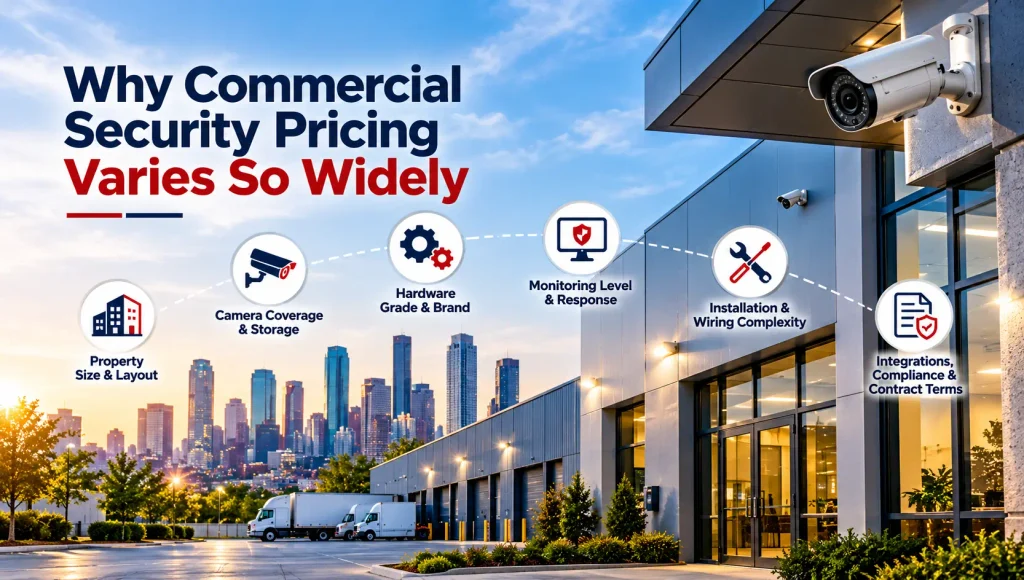
A home installation is designed around your business’s operations, as opposed to one in a home. The factors affecting commercial security system cost fall into three groups: the property itself, the hardware you choose, and the ongoing service you sign up for. There’s a one time and a monthly side to each group and a low upfront price can easily be a high monthly cost.
1. Property Size and Layout
The larger the buildings, the more devices are required. The number of sensors, cameras and keypads you need is based on your total square footage, and is used to cover entrances, hallways, loading areas and storage rooms. A 1,500 sqft little boutique is just another project as a 40,000 sqft warehouse is another project.
It’s not only the arrangement of the characters that counts—it’s also the layout! Alarm systems segment a building into protected areas and the size of the protected area determines the number of zones, which in turn determines the size of the alarm panel, the number of sensors, and the amount of programming time. A single open floor can be easily protected. This office is not an office with a server room, private suites and several exterior doors.
2. Camera Coverage and Storage
Often the largest expenditure is video. Camera count impact cost, as each camera requires the camera unit plus cabling, mounting hardware and storage space for captured footage. Resolution, night vision and weatherproofing are added as are analytics like license plate recognition or people counting. Storage options also play a role—the price of on-site recorders is higher, and the cloud-based solution has an ongoing expense.
3. Hardware Grade and Brand
Equipment quality is where budget and long-term value collide. Commercial-grade sensors, tamper-resistant panels and weatherproof cameras cost more than consumer-grade cameras, but are more likely to last longer, be less prone to failure and are warranted longer. Of all the factors affecting commercial security system cost, hardware grade is the one most likely to save or waste money over a five- to ten-year lifespan.
4. Monitoring Level and Response Options
Professional monitoring is an ongoing cost, which is based on the monitoring tier. Simple systems notify a central station of alarm signals. Video verification, mobile alerts, open and close reporting and guard dispatch are additional features for higher plans. The duration of the contract can also have an impact on the rate, as the longer the contract, the lower the rate.
5. Installation and Wiring Complexity
Oftentimes installation labor is overlooked. It takes more crew hours to install cable through concrete walls, drop ceilings or across multiple floors than to install devices in a “free space” room. The cost can be higher for older buildings, after hours work shifts, or for remote sites. Wireless devices lower the amount of wiring, but can be more expensive per unit and require more robust network planning.
6. Integrations, Compliance, and Contract Terms
Many businesses have alarms integrated with access control, fire systems or building automation. There is hardware and set up time per integration. There are also industry requirements that come into play: for instance, healthcare, finance, and cannabis operations may have specific video retention or access logging requirements. Other items include additional line items like local permits, insurance, false alarm fees, etc. Lastly, see if equipment is leased or bought outright, as a leased piece of equipment will cost more over time, but will cost less up-front.
Business Alarm Cost Breakdown at a Glance
Here are some approximate ranges for a small to mid-size business: The actual price is dependent on the region and the provider.
| Security System | Cost Factors | Estimated Cost |
|---|---|---|
| Alarm Panel and Sensors | Building size, protected areas | $1,000 – $5,000 |
| Video Surveillance | Cameras, resolution, storage | $2,000 – $15,000+ |
| Access Control | Doors, readers, credentials | $1,500 – $10,000 |
| Setup and Wiring | Facility complexity, crew time | $500 – $5,000 |
| Monitoring | Service level, response options | $30 – $150+ per month |
| Maintenance and Support | Plan type, inspections | $20 – $100 per month |
These ranges show why the factors affecting commercial security system cost cannot be reduced to one flat number.
How to Get an Accurate Security System Estimate
The first step in a good quote is a good site survey. Follow these steps:
- Don’t take a phone quote; ask to come on site for a walk-through instead.
- Ask for a business alarm cost breakdown that separates equipment, setup, monitoring, and maintenance.
- Make at least three bids for the same scope.
- Confirm warranty length, service response times, and cancellation terms.
- Ask about price increases at renewal.
Place each quote next to the commercial security pricing factors above for a clear understanding of why one quote is more expensive than the other. There are lots of low-priced offers that simply don’t include something that shows up as a change order. Reviewing the factors affecting commercial security system cost before the walkthrough also makes you a sharper buyer.
Hidden Costs to Watch For
Even if a quote is well written it may still fall short of expenses. When you read a quote check for inspection fees, network upgrades, extra user licenses, activation fees and permit charges. Also confirm who will be responsible for repairs once the warranty has expired. Understanding the factors affecting commercial security system cost includes knowing what is not listed on the first page.
Ways to Reduce Cost Without Cutting Protection
- Focus on high-risk areas such as entrances, cash handling areas and inventory rooms.
- Opt for systems with sufficient capacity to accommodate additional equipment as needed.
- Get alarm, video and access control from a single source.
- Discuss monitoring parameters and hardware.
- Install during off-peak times of the year.
Smart planning around the factors affecting commercial security system cost can lower your total without leaving gaps.
Final Thoughts
There is no one-size-fits-all price for security. Every business is different. Some have risks. Others have complex layouts. Goals also vary from place to place. That’s why costs change. By weighing the factors affecting commercial security system cost, comparing detailed quotes, and planning for recurring fees, you can invest in protection that fits both your budget and your risk.
If you’re ready to get a quote for your project, schedule a site survey. A real person will come to your property. They’ll look at your space and your needs. Then they’ll give you a custom quote. It’s made for your business.