

Contract vs. No-Contract Alarm Monitoring: What Houston Business Owners Should Know
Getting a storefront, warehouse, or office is just 50% of the choice. The other 50% is how you pay for it. Contract vs no-contract alarm monitoring is one of the most critical decisions you need to make as a Houston business owner, not only in terms of your monthly expenses, but also your flexibility and business options when it comes to switching up your direction. A security plan that worked last year might not work next year, with the ever-changing leases and fast-growing commercial corridors in between hurricane seasons. This guide covers the workings of each approach, so you can make your selection with confidence.
Make the opening more naturalStrengthen the Houston-business focus
How Commercial Alarm Monitoring Is Priced
Most systems come with two components: the hardware (control panels, door sensors, motion detectors, cameras) and the monitoring service — the central station that receives alerts and dispatches the police, fire or medical team.
Older firms may sell the equipment at a discount or even for free and make up the price through a commitment of multiple years. Other companies sell the equipment and offer you the option to pay monthly for monitoring; there’s no long-term contract. There’s not a “best” model; it just depends on the person. The important thing is if it reflects your business’s operation.
Contract vs No-Contract Alarm Monitoring at a Glance
| Typical Term | 3 to 5 Years | Month to Month |
|---|---|---|
| Upfront Hardware Cost | Low or free | Higher |
| Monthly Rate | Often lower | Often slightly higher |
| Leaving Early | Fees apply | Cancel anytime |
| Hardware Ownership | Often held by the provider | Usually yours |
| Best For | Stable, long-term locations | Leased spaces, startups, growing teams |
What to Look For in Alarm Monitoring Contract Terms
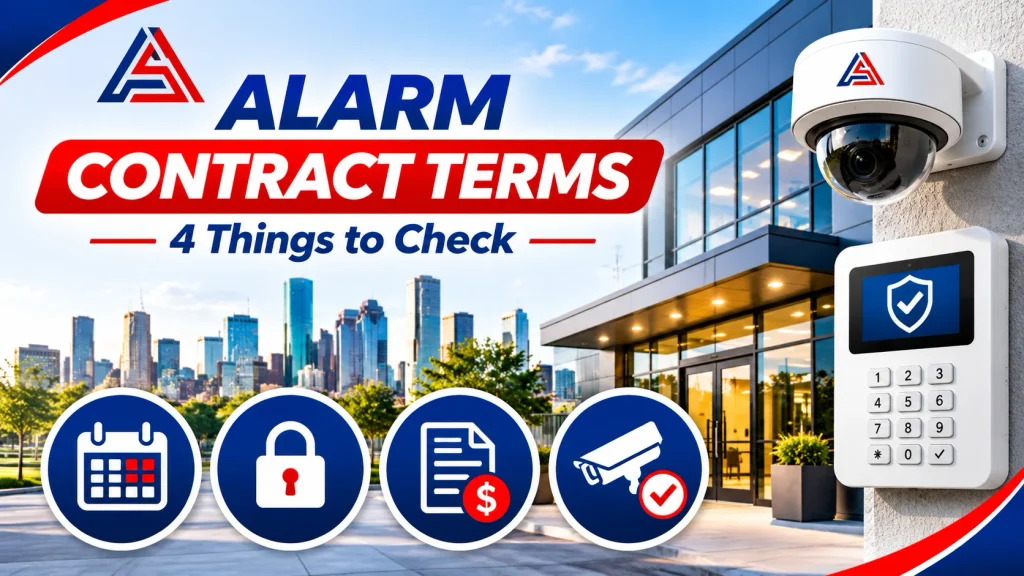
When considering the best alarm monitoring contract terms, don’t just look at the monthly costs. The actual payments down the road depend on the fine print. There are four points to focus on:
- Monitoring agreement length: Most commercial contracts last for 3 to 5 years, and often can renew automatically without any notice from you.
- Lock-in period: Even if a plan is offered as flexible, some may have an initial period where you must remain for a certain length of time, or face a penalty.
- Early termination fee: If terminated early, you may be charged most or all of the remaining payments.
- Equipment ownership: If the panel, sensors, and cameras are owned, can you change monitoring companies without having to pull everything up?
If the salesperson is short on specifics on any of these, request written answers.
The Case for a Contract
It’s not a bad trap to enter into contracts. Whereas, when it comes to contract vs. no-contract alarm monitoring, a contract will benefit the business that intends to remain in a single place for years. You’ll pay less upfront, you’ll likely have this professionally installed for you, and your costs will remain steady and won’t rise. There are some contracts that even include maintenance and replacement of equipment, making budgeting easier.
The tradeoff is reduced freedom. When there’s a drop in service or a business moves, it can be expensive to get out.
Why Many Houston Businesses Prefer Flexibility
The world of business is fast-paced in Houston. There are lots of owners that lease out their space, and a lease that ends in two years is not suitable for a five-year commitment! It is in this regard that month-to-month business alarm plans come into play. There are no upfront costs, you can leave it anytime and you can switch providers if they don’t do a good job.
Month to month business alarm plans are also suitable for seasonal businesses, businesses just starting out, and businesses expanding to second or third locations. The price tag is typically an initial investment in more expensive gear and an increase in costs for the monthly rates.
Houston-Specific Factors to Consider
Considerations other than the contract itself must be taken into account, as this is a matter of local conditions:
- Storm resilience: Outages and flooding are a threat in the Gulf Coast area. Select a system that has battery backup and cellular communications, allowing for monitoring after power outages or when the telephone lines and Internet are down.
- Insurance savings: Ask your insurance agent if he or she will discount premiums on the professionally monitored systems, as some commercial insurance companies do.
- Central station quality: Ensure that it has a central station with quick and verified response times, and that it is UL-listed.
Take these features into consideration. Reliability in storms would be more important than a couple of dollars a month in the contract vs no-contract alarm monitoring decision.
How to Exit an Alarm Contract
Occasionally, the situation can evolve from the time you sign. If you wish to cancel business alarm contract paperwork, or you just don’t wish to have it renewed automatically, proceed in this way:
- Read the cancellation clause. Pay attention to the notice period, which is typically 30-90 days prior to renewal.
- Send a written notice. You’re protected by certified mail or other trackable service.
- Ask about alternatives. Some providers will permit the transfer of the lease to a new address or will take over the lease by a new tenant.
- Document service problems. If you miss the signals or it takes too long to respond, it may be easier to pull a case for a waiver.
- Get confirmation in writing. Keep proof that the account is closed.
The exit rules for signing mean that it’s a lot easier to cancel business alarm contract obligations later without being hit with a surprise charge.
Which Option Fits Your Business?
There are a few ways to figure out a contract vs no-contract alarm monitoring:
- Choose a contract if you own your building, plan to stay put, and want the lowest monthly cost.
- Choose a no-contract plan if you lease, expect to grow or relocate, or want leverage to switch providers.
- Consider a hybrid such as a short one-year term with a modest exit fee, which offers some savings without long-term risk.
Questions to Ask Before You Sign
Make sure to ask these questions of all providers before committing. Making the contract vs no-contract alarm monitoring comparison comes easier:
- Is the plan automatically renewed and what is the notice requirement?
- What will the system transfer if we move?
- Do we own the hardware, and can another company monitor it?
- Does the central station have a UL listing and is there a cellular back-up system?
- What exactly does it cost to leave early?
Common Mistakes to Avoid
When searching for a business telephone service, the monthly price is the main consideration that business owners will consider and will forget about renewal clauses. Some people think that “no contract” means “no commitment” and find out that hardware financing is a part of the program. Last, but not least, many don’t consider compatibility with their equipment, which could make an easy provider change a costly replacement. All three problems can be avoided by careful comparison of contract vs no-contract alarm monitoring options.
Final Thoughts
There is no universal winner in contract vs no-contract alarm monitoring. A contract is about stability and lower costs, and a no-contract plan is about flexibility and freedom to adapt. Make sure it is consistent with your lease, your growth plans and your risk tolerance; read each clause, and ask for answers. A plan that won’t get your Houston business trapped is the one that you should sign.
Ready to compare plans? Get a free quote and understand the terms, cost and equipment prior to committing.